
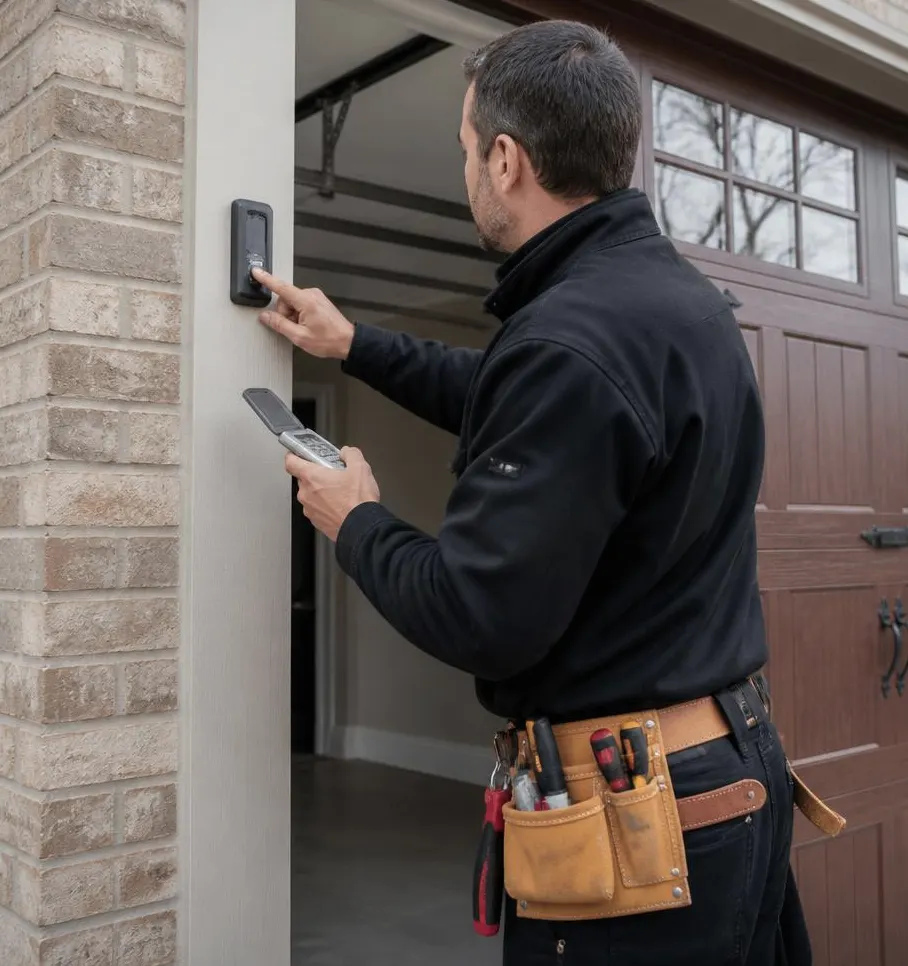
The first thing most homeowners do when the opener stops responding is swap the remote batteries and call it fixed. It's tempting because it's cheap, it takes thirty seconds, and sometimes it actually works. But when the door still won't budge after new batteries, the next move people make is assuming the whole unit is dying and starting to shop for a replacement opener — skipping over several free or low-cost fixes a technician would check first.
Before you spend money on a new unit, it helps to know what the actual symptoms are telling you, and then work through the causes in the order that makes sense.
What This Usually Looks Like
- The remote does nothing — no light, no click, no door movement
- The wall-mounted button doesn't work either, or only sometimes
- The opener light flashes a certain number of times when you press the button
- The door opens a few inches, reverses, or stops partway
- Everything worked fine yesterday and now, with no warning, nothing happens
Each of these points to a different stage in the system, so it's worth checking them in order rather than guessing.
Step 1: Confirm the Opener Has Power
Garage door openers plug into a standard outlet, and that outlet is often on its own circuit or a GFCI breaker. Heavy rain and humidity in this area can trip a GFCI outlet without any obvious sign, so check for a reset button on the outlet itself before assuming anything electrical inside the opener has failed. Also glance at your breaker panel — surges from storms, including the remnant systems that sometimes move through Georgia this time of year, can knock a breaker without tripping the whole house.
If the opener's motor unit has a light that normally comes on when you walk under it, and that light is dark, start here. This is the fastest check and rules out the simplest cause.
Step 2: Check the Remote and the Wall Button Separately
If power is fine, test whether the problem is the remote, the wall button, or both. If the wall button works but the remote doesn't, the remote itself may need new batteries (confirm this is actually what you tried, not just assumed), or it may have lost its programming — a power surge or a reset can wipe this. Reprogramming a remote is usually a five-minute job following the steps printed on the opener's motor housing.
If neither the remote nor the wall button works, the issue is further upstream, and you move to the next check.
Step 3: Inspect the Safety Sensors
Every opener built in the last few decades has two photo-eye sensors near the bottom of the track, usually with small LED lights. If these sensors are misaligned, blocked, or dirty, the opener will often refuse to respond at all, or it will reverse the door immediately after it starts moving. This is one of the most common causes in this area, because pollen film, pine debris, and spiderwebs build up on the lenses, especially after a wet spell. Wipe both lenses with a soft cloth and make sure nothing — a rake, a trash can, a stray branch — is sitting in the sensor beam. Check that both sensor brackets are still tightly bolted down and pointed directly at each other; a bump from a car or a lawn tool can knock them out of alignment just enough to cause intermittent failures.
Step 4: Rule Out Interference
Newer LED bulbs, some security cameras, and certain routers can interfere with the radio frequency a remote uses to talk to the opener. If the wall button works fine but the remote is unreliable only some of the time, this is worth considering, especially if the problem started after you installed new lighting or electronics near the garage.
Step 5: Check Limit Settings and Mechanical Resistance
If the door opens partway and stops or reverses, the opener's force or limit settings may need adjusting, or something mechanical is fighting the motor — a track that's swollen or shifted from humidity, a roller binding, or debris in the track. This is more of a mechanical issue than an electrical one, and forcing the limit settings higher without fixing the underlying resistance just stresses the motor further.
Step 6: The Logic Board or Motor
If power is confirmed, the remote and wall button are both unresponsive, the sensors are clean and aligned, and there's no mechanical resistance, the circuit board or motor itself may have failed. This is the least common cause but the most expensive to fix, and it's genuinely the point where a technician's diagnosis saves you from buying the wrong part.
When to Call Whitesburg Garage Door
If you've checked power, batteries, sensor alignment, and the door still won't respond — or it responds erratically — it's time to call in a second set of eyes. Whitesburg Garage Door handles both garage door opener repair and installation and general garage door maintenance, and we can tell within minutes whether you're looking at a $20 sensor fix or a motor that's actually done. We serve Whitesburg, Carrollton, Villa Rica, Temple, Bremen, Douglasville, Bowdon, and Tallapoosa, and we show up when we say we will.
If your opener in Whitesburg, GA is ignoring the remote or the wall button, give us a call before you replace anything — we'll get it working or tell you honestly what it needs.